Reflection and Planning
Topic outline
-
-
In this guide, we will explore key frameworks, tools, and strategies designed to help teachers reflect and plan effectively within Scottish schools.
Reflection and planning are critical for continuous improvement in teaching. They allow educators to refine their practices, ensure that student learning is optimised, and adapt to the ever-changing demands of the classroom. This guide will draw from various expert sources and provide a structured approach to embedding reflection and planning into your professional practice.
-
-
-
In this section, we'll explore the transformative power of lesson observations. We'll delve into practical strategies and tools that can elevate lesson observations from routine check-ins to powerful opportunities for professional growth. By focusing on specific aspects of teaching and providing actionable feedback, we can create a culture of continuous improvement and enhance student learning.
Listen to the following audio clip.
-
Using the Effective Observation Leading to Effective Assessment guidance from Education Scotland, answer the following:
- What steps could you take to ensure that your lesson observations lead to meaningful changes in your planning and teaching?
- How can observation data inform your future lesson plans and strategies for student engagement?
-
-
-
In this section, we'll delve into the importance of reflection as a catalyst for professional growth. We'll explore how to use various tools and techniques to evaluate your classroom practices and enhance student learning. By reflecting on your teaching, you can identify areas for improvement and implement strategies to optimise your instructional delivery.
Listen to the following audio clip.
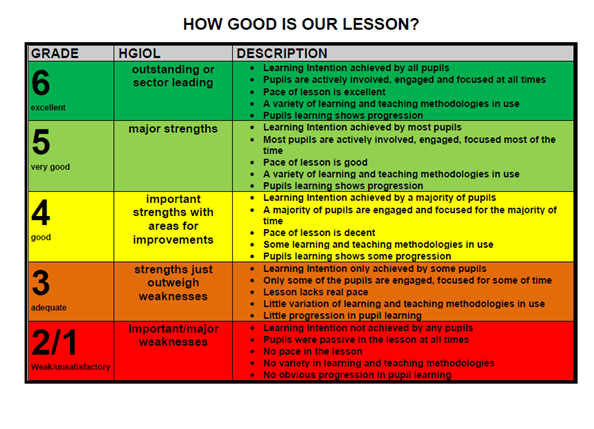
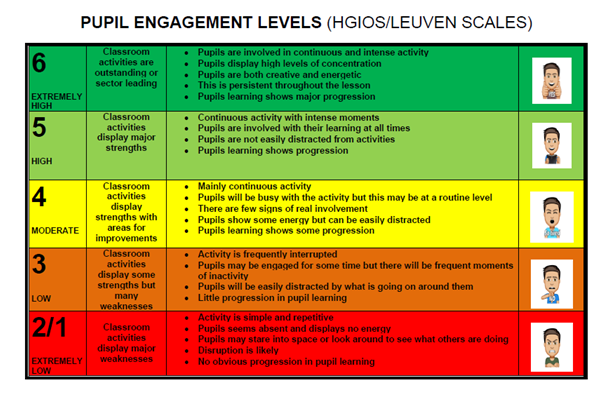
-
Activity 1
Reflect on a recent lesson or collaborate with a colleague to observe one of your lessons. Use the HIGIOS and the LEUVEN Scale to grade the lesson and pupil engagement.
Use this reflection to plan your next lesson.
-
Use the Learning and Teaching Health Check to reflect on your lessons using pupil voice. (click on Activity 2)
Some things to consider for pupil voice:
• Are lessons focused on developing your skills across the curriculum – including Literacy, Numeracy, H&WB
• Are you encouraged to take responsibility for moving your learning forward? Do you get to make choices about your learning
aims?
• Are lessons challenging and varied?
• Are the resources you use in lessons available and of good condition? Do your teachers encourage the use of digital resources?
• Do you engage in learner conversations with your teachers? Do you know where you are on your personal learning journey?
• Do teachers give you effective feedback which helps you to move forward with your next learning steps?
• Do teachers use a variety of different learning methodologies and techniques? -
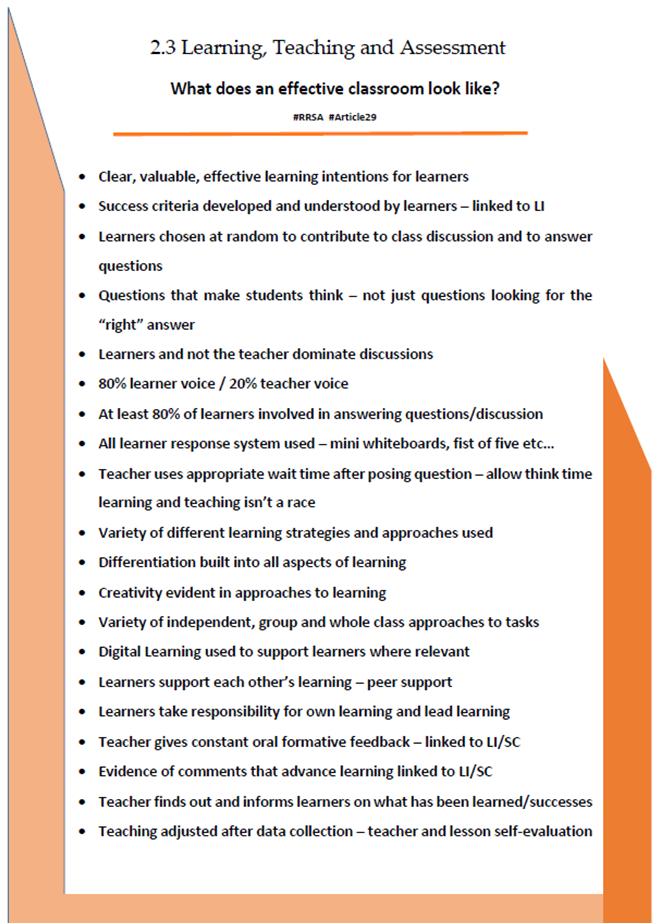
What does an effective classroom look like?
Using the Effective Teaching, Learning and Assessment checklist, reflect on the teaching and learning in your classroom by using Red/Amber/Green. Click on Activity 3 to download the document.
-
-
-
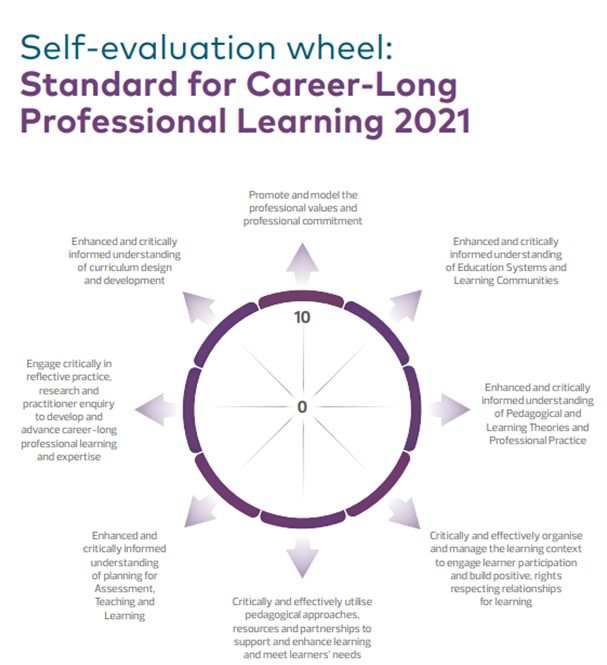
To facilitate professional growth and reflection use the GTCS Self-Evaluation wheels to rate your practice in areas such as pedagogy, classroom practice, professional values, and leadership by marking your self-assessment on the wheel. After completing the ratings, you can identify strengths to celebrate and prioritise one or 2 areas for growth. Using these insights, you can outline a personal action plan with specific, measurable goals and strategies for professional development. To maintain momentum, schedule regular intervals for revisiting the wheel and tracking progress, refining the plan as needed. This reflective process encourages ownership of development and fosters continuous improvement.
You can access self-evaluation wheel resources here:
Self-evaluation wheel: Standard for Career-Long Professional Learning
Self-evaluation wheel: Standard for Full Registration

-
This micro-learning course has equipped you with the knowledge and tools to elevate your teaching practice. You've delved into the power of effective lesson observations, explored the transformative nature of reflection, and discovered the importance of incorporating learner voice. To maximise your professional growth, implement these strategies, collaborate with colleagues, and seek ongoing learning opportunities. By doing so, you'll become a more reflective, impactful, and student-centered educator.
-
-
-
Links to the resources are available on the FVWL Learning Teaching and Assessment Thinglink
- Lesson Observations Supporting Great Teaching by Iris Connect
- Quality Observations for Improving Practice research paper by Prof. Rob Coe et al.
- Danielson Group – FFT Framework for Teaching Tool
- Effective Observation leading to Effective Assessment by Education Scotland
- What Makes Great Teaching research paper by Rob Coe et al.
- 2.3 LTA What Does an Effective Classroom Look Like? – Checklist
- How Good is Our Lesson/Leuven Pupil Engagement – Checksheets
- 2.3 Examples of Good Practice Checklist
- GTCS Self Evaluation Wheels – Career Long PL and Full Registration:
-
-
-
Here are some ideas for professional enquiry focused on reflection, forward planning and pupil voice.
Your Reflection Practice
Focus: Deepening understanding of personal reflection practices.
Steps:
-
Review Reflection Models: Study the various reflection models (e.g., Gibbs' Reflective Cycle, Kolb's Experiential Learning Cycle) and identify key stages and questions.
-
Self-Assessment: Reflect on your current reflection practices. Do you regularly engage in reflection? What types of reflection do you typically use?
-
Identify Strengths and Weaknesses: Analyse your reflection practice to identify areas of strength and areas for improvement.
-
Set Goals: Set specific goals for developing your reflection practice, such as incorporating more diverse reflection techniques or dedicating more time to reflection.
-
Action Planning: Create an action plan outlining the steps you will take to achieve your goals.
Implementing Learner Voice in the Classroom
Focus: Enhancing learner engagement and ownership of learning.
Steps:
-
Research Learner Voice Strategies: Explore various strategies for incorporating learner voice, such as student surveys, interviews, focus groups, and self-assessment.
-
Plan for Implementation: Choose one or two strategies to implement in your classroom. Develop a plan for how you will introduce these strategies to your students.
-
Implement the Strategy: Put your plan into action. Observe how students respond to the new strategy and gather feedback.
-
Reflect on the Impact: Reflect on the effectiveness of the strategy. Did it enhance student engagement and ownership of learning? What challenges did you encounter?
-
Adjust and Improve: Based on your reflection, make adjustments to your strategy to improve its effectiveness.
Developing a Forward Planning Framework
Focus: Improving the quality of lesson planning.
Steps:
-
Review Effective Planning Practices: Research best practices for lesson planning, such as backward design and the use of learning objectives.
-
Analyse Your Current Planning: Evaluate your current planning practices. Are your plans clear, concise, and focused on student learning outcomes?
-
Develop a Personalised Planning Framework: Create a planning framework that suits your teaching style and the needs of your students. Consider incorporating elements such as learning objectives, assessment strategies, differentiation, and resources.
-
Implement the Framework: Use your new framework to plan a series of lessons.
-
Reflect on the Impact: Evaluate the effectiveness of your new planning framework. Did it improve the quality of your lessons? Did it enhance student learning outcomes?
Collaborating with Colleagues to Enhance Reflection and Planning
Focus: Building a professional learning community.
Steps:
-
Identify a Collaborative Partner: Find a colleague who shares your interest in reflection and planning.
-
Set Shared Goals: Together, set specific goals for your collaborative inquiry, such as improving reflection practices or developing a shared planning framework.
-
Regularly Meet and Reflect: Schedule regular meetings to discuss your experiences, share ideas, and provide feedback.
-
Engage in Joint Reflection: Reflect on your collaborative practices. What worked well? What could be improved?
-
Share Your Learning: Consider sharing your findings with a wider audience through presentations, workshops, or blog posts.
Remember to document your reflections, observations, and findings throughout these activities. This documentation can be used to inform future professional development and share your learning with others.
-
-