Session 4 - Driving Data-Driven Results: Implementation Planning
| Site: | CLPL |
| Course: | Data Champions |
| Book: | Session 4 - Driving Data-Driven Results: Implementation Planning |
| Printed by: | Guest user |
| Date: | Saturday, 5 September 2026, 12:53 AM |
Description

The Implementation Plan
"Our aim through this programme is to create a culture of curiosity around data, where practitioners at all levels are comfortable with and confident in exploring a range of data to inform improvement priorities and next steps for learners."
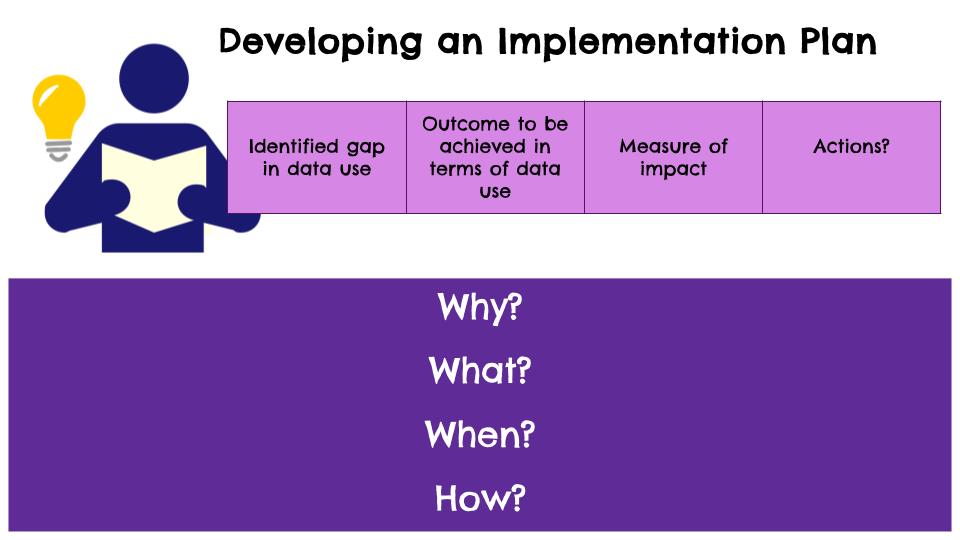
Section 1: Developing an Implementation Plan
Welcome! This section will guide you through the fundamentals of creating and using an effective implementation plan. As you can see from our opening statement, our aim is to foster a culture of data curiosity and confidence. An implementation plan is your roadmap to achieving this and other important goals.
Why Use an Implementation Plan?
Imagine setting out on a journey without a map or destination in mind. You might wander aimlessly, waste resources, and never reach your intended goal. Similarly, without an implementation plan, your efforts to improve and innovate can become scattered and ineffective. An implementation plan is crucial because it:
|
What is an Implementation Plan?
An implementation plan is a detailed, step-by-step guide that outlines how you will achieve a specific goal or objective. It typically includes:
In the context of our program, it helps us identify gaps in data use, define desired outcomes, and measure the impact of our efforts. |
When Should You Use an Implementation Plan?
An implementation plan is valuable in various situations, including:
|
How Do You Create and Use an Implementation Plan?
Creating an effective implementation plan involves several key steps:
|
Creating Your Implementation plan
Let's Get Started
In this section of the course, we'll walk you through the process of creating your own Data Champions implementation plan. To assist you, we've provided a downloadable template that you can use to document your plan. We'll take you through each step of the template, providing guidance and examples along the way.
Click here to download the template
Click here to create your own copy of the implementation plan in your Google Drive
Step 1: Identified gap in data use
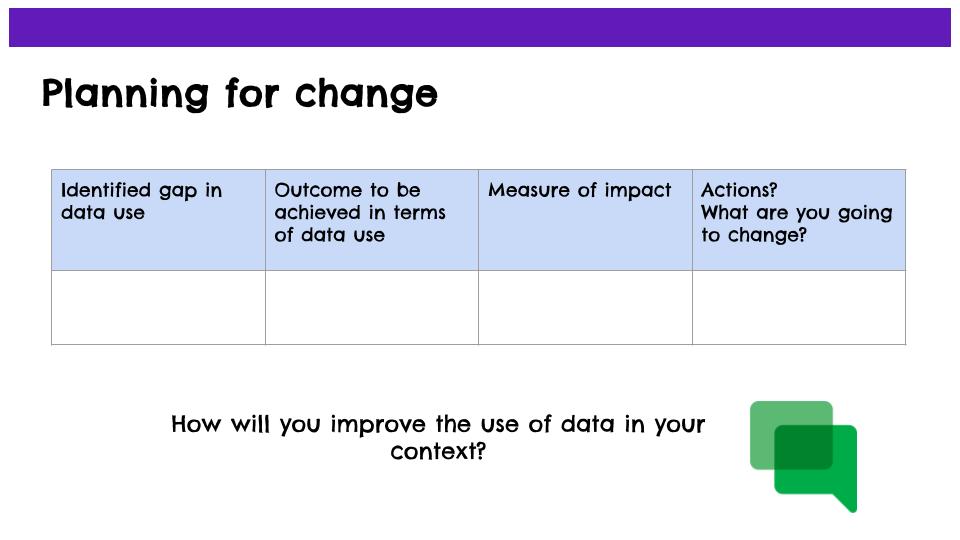
Step 1: Identified Gap in Data Usage
Welcome to the first step in creating your Data Champions implementation plan! This stage is all about pinpointing a specific area where your setting's use of data could be improved.
Take a close look at the image above. It's a simple framework, but it's the foundation for your plan. The first column, "Identified gap in data use," is where we'll focus now.
How Do You Identify a Gap?
There are several ways to uncover gaps in your current data practices:
- Data-Driven Dialogue: Have you recently engaged in a structured data-driven dialogue? These conversations can be incredibly insightful. If so, revisit your notes. Were there any recurring themes or concerns raised? Did any specific data points reveal a lack of understanding or utilization?
- Feedback: Consider feedback from teachers, staff, students, or even parents. Have they expressed any frustrations or confusion regarding data? Are there areas where they feel data is not being used effectively?
- Observations: Reflect on your own observations. Are there instances where data is collected but not analyzed? Are there missed opportunities to use data to inform decision-making?
- Review of Current Practices: Take a look at your current data collection, analysis, and reporting processes. Are there any bottlenecks or inefficiencies? Are there specific types of data that are consistently overlooked?
What Exactly is the Gap?
Once you've identified a potential gap, it's crucial to be specific. Avoid vague statements like "We don't use data enough." Instead, aim for concrete descriptions. For example:
- "Teachers are not consistently using student assessment data to differentiate instruction."
- "We lack a clear system for tracking and analyzing student attendance data."
- "Parents are not receiving timely and relevant information about their child's progress based on data."
- "We are not effectively using student feedback surveys to inform school improvement efforts."
Being Specific is Key
The more specific you are in defining the gap, the more targeted and effective your implementation plan will be. Think of it like this: if you're trying to fix a leaky faucet, you need to know exactly where the leak is coming from.
Take some time now to reflect on your setting's data practices. Use the prompts above to guide your thinking. Write down the specific gap you've identified in the first column of the framework.
This focused approach will set you up for success in the following steps of your implementation plan.
Step 2: Outcome to be Achieved in Terms of Data Use
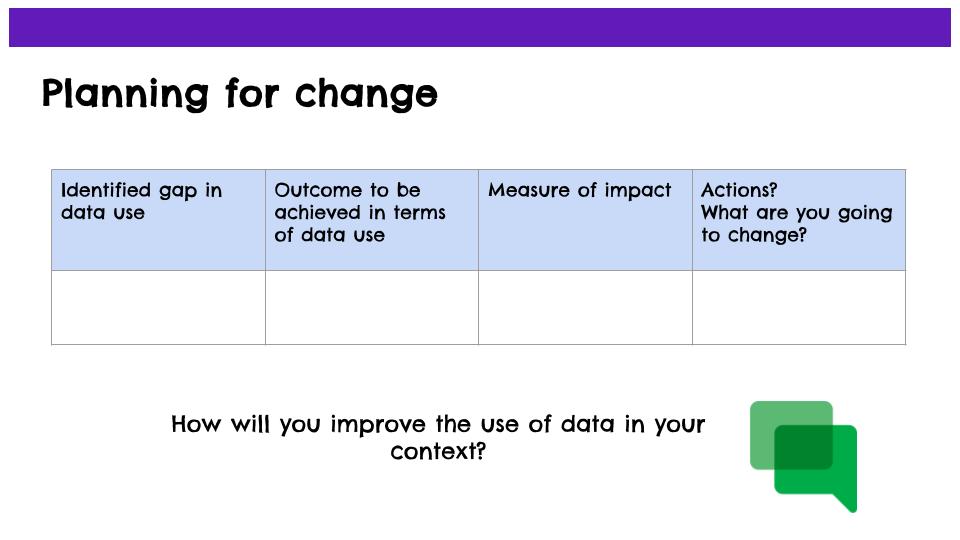
Step 2: Outcome to be Achieved in Terms of Data Use
Great job on identifying a specific gap in your setting's data usage! Now, let's move on to defining the desired outcome. In other words, how will you know if you've successfully addressed the gap?
What Does Success Look Like?
The key here is to be specific and measurable. What exactly do you want to achieve in terms of data use?
- Measurable: How will you quantify the change? Can you use numbers, percentages, or other concrete metrics?
- Achievable: Is the outcome realistic and attainable within your context?
- Relevant: How does the outcome align with your setting's overall goals and priorities?
- Time-bound: When do you expect to achieve this outcome?
Examples of Outcomes
Let's revisit our examples from Step 1 and craft some specific outcomes:
- Gap: "Teachers are not consistently using student assessment data to differentiate instruction."
- Outcome: "By the end of the autumn term, 80% of teachers will report using student assessment data to inform their lesson planning at least weekly."
- Gap: "We lack a clear system for tracking and analyzing student attendance data."
- Outcome: "By the start of the next academic year, we will have implemented a new attendance tracking system that allows for easy analysis of attendance patterns."
- Gap: "Parents are not receiving timely and relevant information about their child's progress based on data."
- Outcome: "Starting in January, parents will receive monthly progress reports that include specific data points related to their child's academic performance."
- Gap: "We are not effectively using student feedback surveys to inform school improvement efforts."
- Outcome: "By the end of the school year, we will have analysed student feedback survey data and used it to identify at least two key areas for school improvement."
Your Turn
Now it's time to define the outcome you want to achieve in your setting. Be as specific and measurable as possible. Write it down in the "Outcome to be achieved in terms of data use" column of your implementation plan template.
Step 3: Measures of Impact
Step 3: Measure of Impact
Now that you've defined your desired outcome, it's essential to determine how you'll measure its impact. How will you know if your plan has been successful? What concrete evidence will demonstrate that you've achieved your goals?
What Will Success Look Like?
This step is about identifying specific metrics and data points that will indicate progress. Think about:
- Quantitative Data: Can you use numbers, percentages, or other measurable data?
- Qualitative Data: Can you gather feedback through surveys, interviews, or observations?
- Existing Data: Can you leverage existing data sources to track progress?
Examples of Measures of Impact
Let's revisit our previous examples and identify potential measures of impact:
- Outcome: "By the end of the autumn term, 80% of teachers will report using student assessment data to inform their lesson planning at least weekly."
- Measure of Impact: "A teacher survey conducted at the end of the autumn term will show that 85% of teachers report using student assessment data in their lesson planning weekly."
- Outcome: "By the start of the next academic year, we will have implemented a new attendance tracking system that allows for easy analysis of attendance patterns."
- Measure of Impact: "The new attendance tracking system will be fully implemented and operational by the start of the next academic year, with documented training provided to all staff."
- Outcome: "Starting in January, parents will receive monthly progress reports that include specific data points related to their child's academic performance."
- Measure of Impact: "Parent feedback surveys conducted in March and June will show a 90% satisfaction rate with the clarity and usefulness of the monthly progress reports."
- Outcome: "By the end of the school year, we will have analysed student feedback survey data and used it to identify at least two key areas for school improvement."
- Measure of Impact: "A report will be presented to the school leadership team at the end of the school year, detailing the analysis of student feedback survey data and identifying two specific areas for improvement."
Your Turn
Now it's time to define how you'll measure the impact of your plan. Be specific about the data you'll collect and how you'll analyze it. Write it down in the "Measure of impact" column of your implementation plan template.
Think about:
- What data will you collect?
- How will you collect it?
- When will you collect it?
- How will you analyze it?
By carefully considering these questions, you'll be able to effectively track your progress and demonstrate the success of your implementation plan.
Step 4: Actions
Step 4: Actions
You've defined the gap, the desired outcome, and how you'll measure impact. Now, it's time to outline the specific actions you will initiate and lead to make your plan a reality.
What Steps Will You Take?
This section is about creating a detailed action plan. For each action, consider:
- What: What specific steps will you initiate and lead?
- When: When will each action take place?
- Resources: What resources will you need, and how will you secure them?
Examples of Actions
Again using the previous examples, what would the actions look like?
- Outcome: "By the end of the autumn term, 80% of teachers will report using student assessment data to inform their lesson planning at least weekly."
- Actions:
- "I will propose and lead a professional learning session for staff on how to effectively use student assessment data for lesson planning by September 15th."
- "I will create and share a resource pack with practical examples of data-driven lesson adjustments by September 20th."
- "I will organise and facilitate informal peer-sharing sessions where teachers can discuss and exchange strategies for using assessment data weekly, starting September 25th."
- Actions:
- Outcome: "By the start of the next academic year, I will have initiated the development of a more consistent approach to tracking and analysing pupil attendance patterns across the school."
- Actions:
- "I will research and present to the senior leadership team a proposal for a school-wide attendance tracking and analysis system by June 1st."
- "I will volunteer to lead a pilot project for implementing the proposed system in my own classes and share findings with staff by June 15th."
- "I will create a user guide for the chosen system and offer to provide initial training to interested colleagues during pre-term in-service days."
- Actions:
- Outcome: "Starting in January, I will initiate a more consistent approach to providing parents with monthly updates that include specific data points related to their child's academic performance."
- Actions:
- "I will develop a template for parent updates, incorporating key data points, and share it with colleagues for feedback by December 15th."
- "I will organise a brief workshop for staff on how to effectively communicate data to parents in these updates by January 10th."
- "I will create a schedule and system for sending out monthly updates to parents in my own classes and encourage others to adopt a similar approach by January 31st."
- Actions:
- Outcome: "By the end of the school year, I will have initiated a process for gathering and analysing pupil feedback data to inform school-wide improvement."
- Actions:
- "I will create a standardised pupil feedback form and propose its use across the school by May 1st."
- "I will offer to collate and analyse the collected feedback data and present key findings to the senior leadership team by June 15th."
- "I will facilitate a staff meeting to discuss the feedback findings and brainstorm potential improvement strategies by June 30th."
- Actions:
Your Turn
Now it's your turn to outline the specific actions you will initiate and lead to implement your plan. Be as detailed as possible, and don't forget to consider when and what resources you'll need. Write it down in the "Actions" column of your implementation plan template.
Also, consider:
- How will you gain buy-in from colleagues and the senior leadership team for your proposed actions?
- What support will you need from others to successfully lead these actions?
- How will you ensure that these actions lead to sustainable change within the school?
By focusing on your role as an initiator and leader, you can create a plan that has a significant impact on your school community.
Carrying out your Implementation Plan
How and when to carry out your implementation plan
Now that you've meticulously crafted your implementation plan, it's time to put it into action. Remember, this plan is your roadmap to improving data use in your setting, so let's make sure it guides you effectively.
1. Bring Your Plan to Life
- Start Now: Don't let your plan gather dust! Begin implementing your action steps as soon as possible. Consistent and timely action is key to achieving your desired outcomes.
- Follow Your Timeline: Pay close attention to the timelines you've set for each action. This will help you stay on track and ensure that your plan progresses smoothly.
2. Regular Check-ins
- Frequent Reviews: Make it a habit to revisit your implementation plan regularly. This could be weekly, fortnightly, or monthly, depending on the scope and pace of your actions.
- Stay on Track: During these check-ins, assess your progress. Are you on track with your actions? Are there any roadblocks or challenges?
3. Collect Data as You Go
- Evidence is Key: As you implement your plan, gather data to monitor your progress. This could include quantitative data (e.g., numbers, percentages) or qualitative data (e.g., feedback, observations).
- Use Your Measures: Refer back to the "Measure of Impact" section of your plan. Are you collecting the data you need to assess your progress?
4. Reflect and Adapt
- What's Working? Take note of what's going well. Which actions are proving to be effective?
- What's Not? Don't be afraid to acknowledge when something isn't working as expected.
- Be Flexible: Based on your reflections and data, be prepared to adapt your plan as needed. This might involve modifying actions, adjusting timelines, or even revising your desired outcomes.
5. Celebrate Successes
- Acknowledge Progress: As you make progress, take time to celebrate your successes, no matter how small.
- Maintain Momentum: Recognizing your achievements will help you and your colleagues stay motivated and committed to your plan.
By consistently implementing, monitoring, and adapting your plan, you'll be well on your way to fostering a data-driven culture in your setting.
Evaluate your implementation plan
How to evaluate your implementation plan
Congratulations! You've implemented your plan and are now ready to evaluate its effectiveness. This crucial step will help you understand what worked, what didn't, and how you can continue to improve data use in your setting.
1. Review Your Original Goals
- Did You Achieve Your Outcomes? Look back at the "Outcome to be achieved in terms of data use" section of your plan. Did you meet the specific, measurable goals you set?
- Refer to Your Measures: Revisit the "Measure of Impact" section. Does the data you collected demonstrate that you achieved your desired outcomes?
2. Ask Critical Questions
- What Worked Well? Identify the actions that were most effective in achieving your goals.
- What Didn't Work? Be honest about the actions that didn't yield the desired results. What were the challenges?
- What Could Be Improved? Based on your experience, what changes would you make if you were to implement the plan again?
- Was the Timeline Realistic? Did you allow enough time for each action? Were there any unforeseen delays?
- Were Resources Sufficient? Did you have the necessary resources (time, materials, support) to implement your plan effectively?
3. Seek Feedback and Collaboration
- Find a Critical Friend: Discuss your plan and its outcomes with a trusted colleague. They can provide valuable insights and perspectives.
- Connect with Other Data Champions: If possible, talk to other educators who have completed the Data Champions course. Share your experiences and learn from theirs.
- Consider a Presentation: Presenting your findings to colleagues or the senior leadership team can help you solidify your understanding and share your learning.
4. Document Your Findings
- Create a Summary Report: Write a brief report summarizing your evaluation. Include your original goals, the actions you took, the data you collected, and your key findings.
- Reflect on Your Learning: Take time to reflect on what you've learned through this process. How has your understanding of data use changed? How will you apply this learning in the future?
5. Plan for Continuous Improvement
- Identify Next Steps: Based on your evaluation, identify areas for further improvement. What actions will you take to continue building a data-driven culture in your setting?
- Make it Sustainable: How can you ensure that the positive changes you've made are sustained over time?
Remember: Evaluating your implementation plan is an ongoing process. It's not just about looking back; it's also about looking forward and continuing to improve data use in your setting.
Put your Skills into Action
As a Data Champion, you'll be faced with a variety of situations that require you to apply your data expertise and leadership. These scenarios are designed to simulate some of those challenges. By working through them, you'll have the chance to strengthen your ability to promote a positive data culture, support colleagues, and ultimately, improve outcomes for learners. Use the questions provided to guide your thinking and explore different approaches.
Scenario 1: The Hesitant PractitionerA practitioner is reluctant to use data, stating they prefer to rely on their experience and professional judgment. Questions:
|
Scenario 2: Data OverwhelmStaff are collecting a lot of data but feel overwhelmed and unsure how to use it effectively to inform their practice. Questions:
|
Scenario 3: Celebrating SuccessA team has implemented a successful data-informed approach that has led to positive outcomes for learners. Questions:
|
Scenario 4: Misinterpreting DataA practitioner has misinterpreted data, leading to a potentially flawed plan.
Questions:
|
Scenario 5: Identifying TrendsA practitioner is presented with a set of data (e.g., assessment results, observations) and struggles to identify key trends or patterns.
Questions:
|
Scenario 6: Using Data for PlanningA team is planning their next steps (e.g., lesson planning, interventions) but is not sure how to use data to inform their decisions.
Questions:
|
Scenario 7: Communicating Data to StakeholdersA practitioner needs to communicate data (e.g., progress updates, assessment results) to parents or other stakeholders but is unsure how to present it clearly and effectively. Questions:
|
Scenario 8: Data and EquityData reveals disparities in outcomes for different groups of learners.
Questions:
|
Complete the course
To complete the course, complete the feedback form