Relationships
Topic outline
-
-
Welcome to this CLPL on the pivotal role of relationships in education. In this session, we will explore the importance of positive relationships in creating a supportive and engaging learning environment. We'll discuss strategies for fostering these connections, the impact they have on student outcomes, and how to implement them in your classroom.
Listen to the audio book and then have a look at the video link.

-
The Power of Relationships
-
-
-
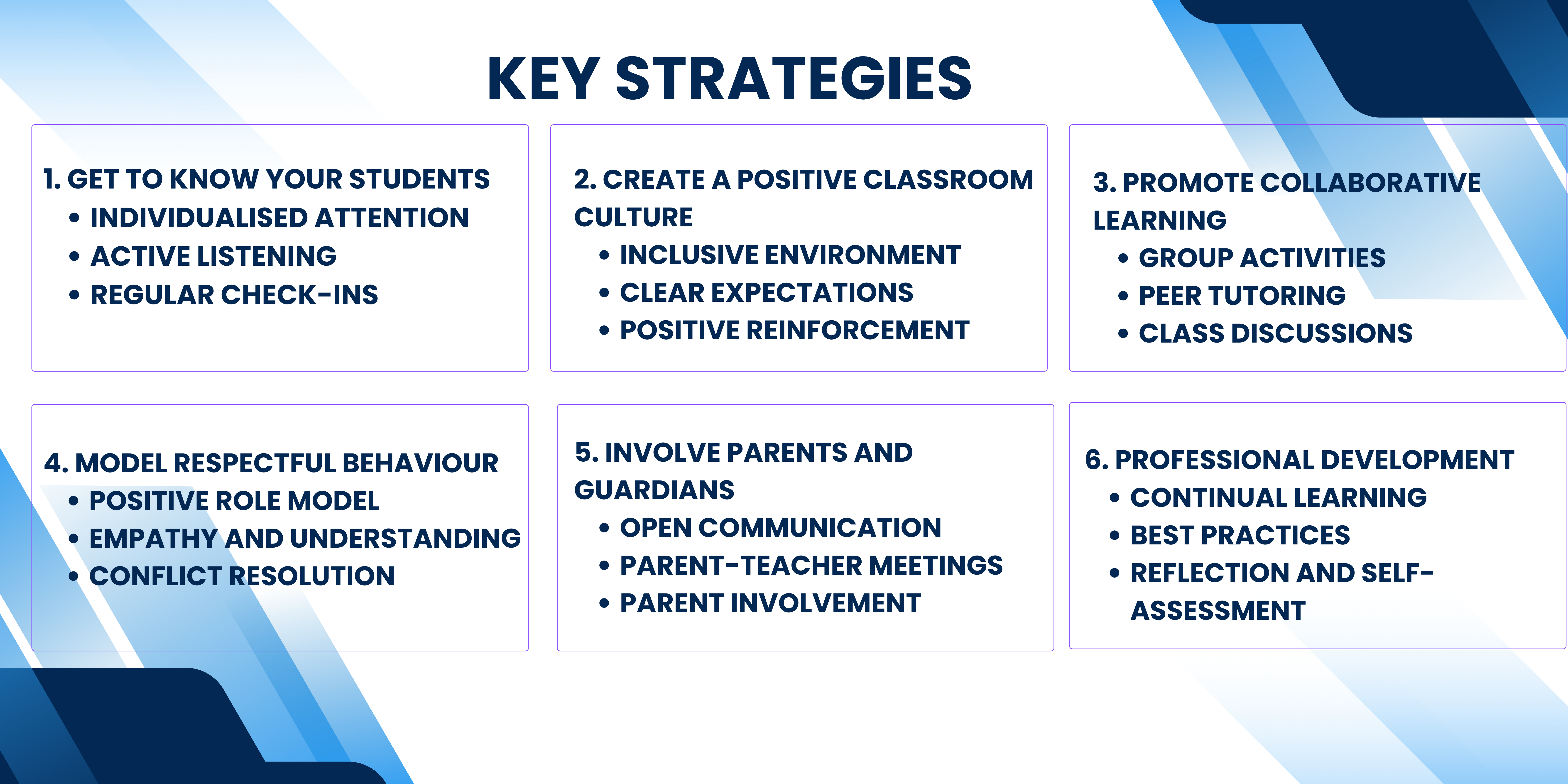
In this session we will focus on practical strategies for cultivating and maintaining positive relationships in your classrooms and schools. These strategies include creating a welcoming and inclusive environment, establishing clear expectations and using restorative practices to address conflicts. Teachers can implement various strategies to foster positive relationships with their students. Listen to the audiobook and explore the other resources for relationship-building strategies including the concept of learner-centred classrooms.
-
The Learner Centred Classroom
-
This link will take you to 23 fun, quick and easy to implement daily or weekly activities to help build and sustain strong classroom communities.
-
Explore some strategies in more detail in this link, why do it and how to do it.
-
Objective: Develop and apply a quick strategy for promoting positive relationships in your classroom.
Click on the link above to access the activity.
-
-
-
Links to Resources:
- The Cornerstone of Learning – Scottish Curriculum: The Cornerstone of Learning
- Promoting Positive Relationships in Educational Settings: Promoting Positive Relationships
- What Scotland Learned – Building Back Better: What Scotland Learned
- The Cornerstone of Learning – Scottish Curriculum: The Cornerstone of Learning
-
-
-
Opened: Wednesday, 4 September 2024, 12:41 PM
Knowledge check for Relationship Micro Module.
-
-
Task 1: Exploring Personal Connection Strategies
Objective: Evaluate strategies to build individual relationships with students.
- Reflect on your current practices for getting to know your students (e.g., check-ins, conversations about interests).
- Research additional methods from the provided material and identify one strategy to implement.
- Test the strategy in your classroom for one week, documenting your observations and student responses.
- Write a reflective journal entry discussing the impact of the new approach on student engagement.
Task 2: Developing a Positive Classroom Culture
Objective: Assess and enhance the inclusivity and culture of your classroom.
- Review your classroom rules, expectations, and reinforcement methods.
- Conduct a short anonymous survey with students to gather their perspectives on the classroom environment.
- Using insights from the survey and the material provided, implement one new technique to foster inclusivity or positive reinforcement.
- Share your findings in a group discussion or staff meeting, including successes and potential areas for improvement.
Task 3: Collaborating with Parents and Guardians
Objective: Strengthen relationships with parents to support student learning.
- Choose one method for engaging parents (e.g., scheduling a parent-teacher meeting, sending a personalised update about their child’s progress).
- Discuss with parents how their involvement influences student outcomes and solicit their feedback on how to improve communication.
- Reflect on the results of the interaction and write a summary identifying how it influenced your relationship with the student and their family.
Task 4: Modeling Respectful Behaviour
Objective: Self-assess and refine respectful interactions in your role as a teacher.
- Record a video or audio snippet of yourself during a class session or interaction with students (with appropriate permissions).
- Review the recording, focusing on your tone, language, and responses to student behaviour.
- Compare your practices to the key points on respectful behaviour from the material.
- Develop a brief action plan to model respectful behaviours more effectively, and track changes in classroom dynamics over the following week.
Task 5: Restorative Justice Practices
Objective: To explore the use of restorative justice practices to address conflicts and build positive relationships.
· Learn about restorative justice principles and practices, including circle time, mediation, and conferencing.
· Develop a plan to incorporate restorative justice practices into the classroom to address conflicts in a constructive and healing way.
· Evaluate the effectiveness of restorative justice practices in promoting positive relationships and reducing conflict.
- Reflect on your current practices for getting to know your students (e.g., check-ins, conversations about interests).